What My First Year of PhD Felt Like
When I got the offer letter for the PhD program in the Department of Computer Science and Engineering at Indian Institute of Technology Delhi, I felt ecstatic — a sense of relief after a year of being unemployed.
But a quote from Dr. Arkaprava Basu, shared during a conversation about working with him, quickly brought things back to earth:
“All of the educational programs deals with consuming knowledge but only PhD additionally involves generating knowledge.”
— Dr. Arkaprava Basu
I started scouring the internet for what I was actually getting into. A blog by Dr. Joe Riad hit closer to home than I expected. The core message: take it one step at a time, because this is a very long ride. But what really stayed with me was the part about isolation — how easy it is to slip into, especially for an introvert. I recognised that pattern in myself immediately. The blog also made a case for having outlets outside research, and I filed that away.
Semester 1: New Territory
When the academic year started in late July 2025, there was a lot to navigate at once — paperwork, meetings with professors, enrolling in courses, and getting used to a new campus and city.
After several conversations with my now advisor, Dr. Rijurekha Sen, I found myself drawn to a project on Privacy Preserving Machine Learning (PPML) using Fully Homomorphic Encryption (FHE). Dr. Paarijaat Aditya from Nokia Bell Labs, Stuttgart, came on as my external co-advisor.
The early months were spent trying to understand the landscape — working with FHE libraries, running experiments, benchmarking. What surprised me was how much I enjoyed it. My previous job as an Associate Software Engineer had a monotony I’d quietly made peace with. Research broke that completely. Every day brought something new to learn or try. And on the days where it felt like nothing was going anywhere, I reminded myself: the blog had told me to expect exactly this.
The first time I had to present what I’d been reading and thinking about to my advisors, it did not go well. I tend to speed up instinctively when I talk, jumping between topics before finishing the previous one, and in that meeting it showed. I couldn’t get across what I had in mind, and it ended early. I was asked to put together a presentation — to structure what I had been trying to explain. The next meeting went much better, and my advisors told me this happens to almost everyone and that everyone gets better at it. I can mostly hold my own now even without slides, but the speedup is something I am still working on.
Isolation had always been the path of least resistance for me, and initiating conversation was genuinely hard — so I started therapy, partly as a response to what I had read. Slowly, that began to shift. Peer discussions started feeling less like an effort. By the end of the semester, at one of the informal dinners the department holds for faculty and PhD students, I found myself talking to professors with an ease I would not have had a few months earlier. The professors shared their PhD and postdoc stories before the meal, and at the table I held conversations instead of retreating. It felt good.
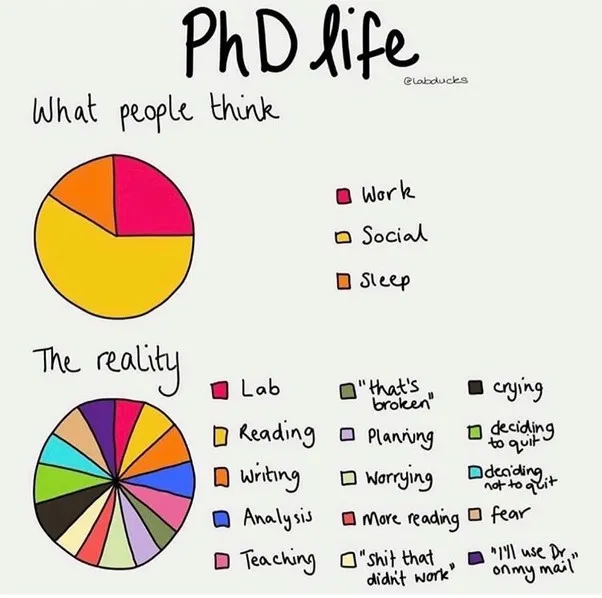 Image credit: Cranfield University
Semester 2: Into the Thick of It
The second semester opened with a collaboration with a senior PhD student, Dr. Mehreen Jabeen, who had recently completed their defense. I ran experiments for a paper they were working on — about five weeks of back-and-forth — after which the paper was submitted and rejected. That didn’t hit as hard as it might have; my contribution had been a small, focused piece rather than the whole thing. But it was a sharp introduction to the brutality of the conference circuit. We revised and resubmitted; it is currently awaiting a response.
There was also a moment that stung more than I expected. I got an opportunity to intern at Bell Labs in Stuttgart with Dr. Aditya and his team — and cleared the interview. First international travel, and more researchers to work alongside: I had genuinely gotten my hopes up. But the required leaves were not possible until I clear my comprehensive exams, so I had to turn it down. Dr. Aditya reassured me there would be other years, and I knew that was true. Knowing it didn’t make it easier.
On the research front, ideas I came up with turned out to have already been published. The first time, I absorbed it. The second time, it stung. I could rationalise it — I had been working in this domain for less than seven months; of course there were people ahead — but rationalisation and feeling are different things. I still have this urge to move faster on any idea I get, knowing others have been working in the same space for much longer.
The TA work was the highlight of the semester. Working closely with
Dr. Abhilash Jindal
on setting exams and building the testing infrastructure, it
felt like I was actually contributing to the course. The discussions were
genuinely engaging; there is something that stays with you when you get to watch
a sharp mind work through a problem in real time. We built testing scripts and
autograders for a step-by-step student implementation of xv6, and when word
got back — unofficially — that students had found the setup well-made, it
meant more than I expected.
A year in, I am still figuring it out. The outlets I had filed away from Dr. Joe Riad’s blog turned into real things: live stand-up comedy shows, a sci-fi novel I restarted and have now brought to nearly 200 pages, and a routine of swimming, gym, and cycling around campus — sometimes past midnight, just to clear my head.
I am grateful for the family and friends who showed up through all of it, but especially through the lows.